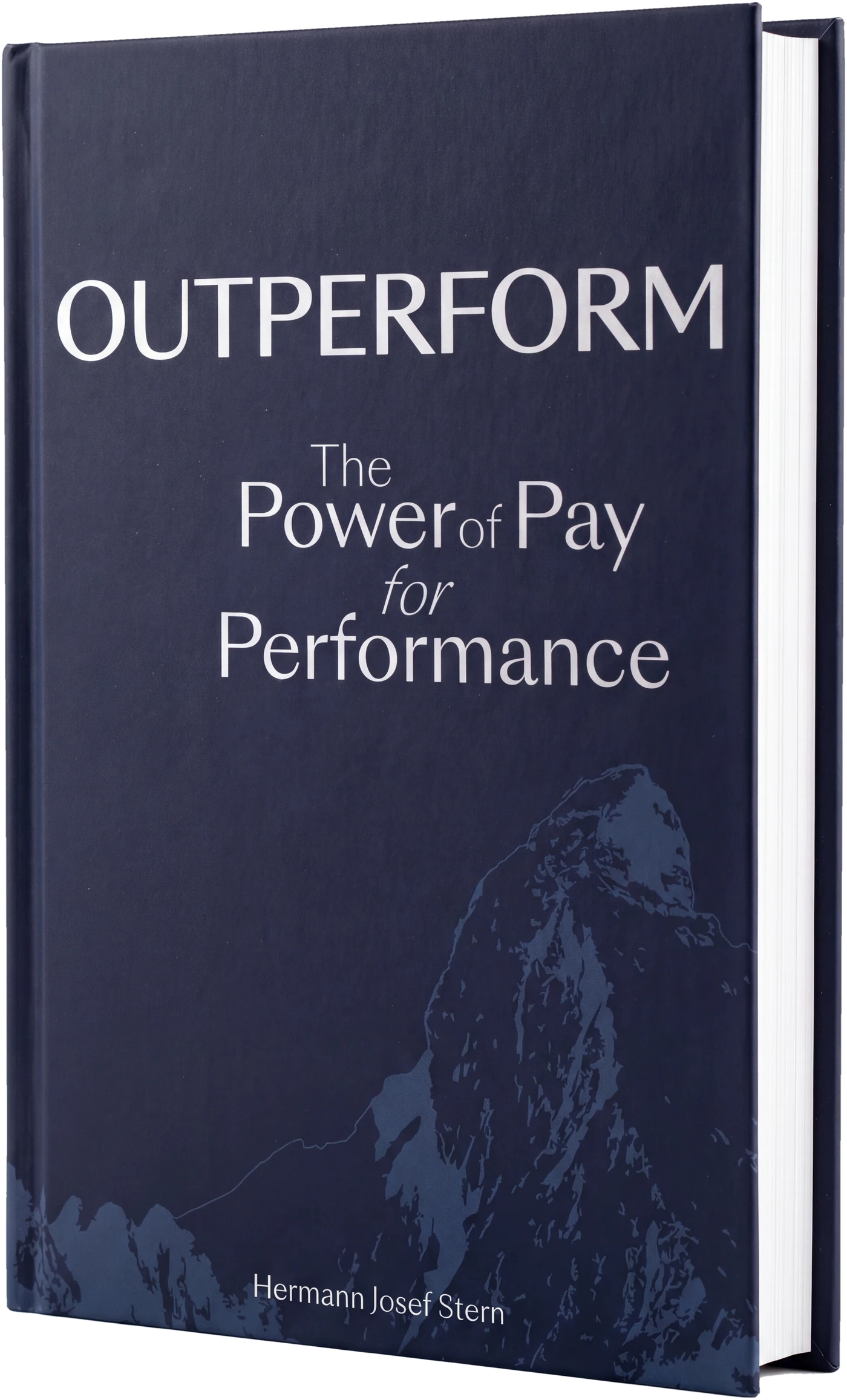
Outperform
The Power of Pay for Performance
Your executives are not paid for performance. They are paid to stay. Outperform proves it with data from three countries — then shows boards the one move that fixes it.
+ CHF 9 shipping to Switzerland
English original edition · Hardcover
The performance illusion
“Cycles, currencies, market tides. Much of what we call performance is just the weather.”
Measured in absolute terms, there is almost no correlation between what executives are paid and how their companies perform. What companies really pay for is retention. Absolute numbers mislead because so much of any result is just weather: the economic cycles, currency swings, and industry tides that lift or sink every company alike. A record year on a rising market is not the same as a well-run company, yet boards reward both as if they were. Outperform takes apart every conventional measure of performance, then offers the alternative: index operating performance against a live field of peers, the way the Olympics ranks athletes against the field rather than the clock. Strip out the weather, and a board can finally see, and pay for, real performance. The method has a name, the Indexing Operating Performance Method, and it is in use at leading companies.
Insights in the book
The traps
Everything boards trust to measure performance, and why it misleads: share prices, stock options, budget targets, ESG ratings, and the two alibis behind them all, motivation and greed.
The fix
One move, index operating performance against real peers, and the board-ready system built on it: the Pay Index Method.
The proof
Real companies, real numbers: Plansee, Zumtobel, Sika, and Trane Technologies.
Full table of contents
- Preface
The Reluctant Compensation Consultant
- Introduction
How to Read the Book
Problems
- Chapter 1
The Motivation Illusion
- Lack of Correlation
- Performance Pay Is Not in the Interest of the Company
- Fixed Pay Isn’t the Solution Either
- Pay-to-Stay Wins Hands Down
- In the Beginning, Pay Was Linked to Profits
- Then, Pay Was Linked to Stock Prices
- Pay-to-Stay: Market Pay Is the Minimum
- Executives Are Not Athletes
- The Pay-for-Motivation Confusion
- Less Motivation with Variable Pay
- High Risk with High Variable Pay
- Why Pay-for-Motivation Research Is Irrelevant
- Cash Is King? The Science of Gifting
- What Boards Should Do
- Chapter 2
The Greed Illusion
- The $450,000 Question
- The Wage Anchor Effect
- The Smarter the Participant, the Worse the Spiral
- Women Anchor Less
- Pay as a Signal
- Pay = Performance
- The Twist: A Better Solution Than Minimum Wage
- Chapter 3
The Performance Traps
- We Can’t Agree on Good
- The Profit Paradox
- The Return Riddle
- Low-Margin Is Not Bad
- The Boardroom Blindspot
- The Depreciation Trap
- Economic Profit Doesn’t Save You
- Pay-to-Downsize
- Chapter 4
The Target Traps
- The Budget Trap
- The Risk Trap
- The Intuition Trap
- The Overconfidence Trap
- Chapter 5
The Stock Price Problem
- How We Think Stock Prices Work
- When the Company Beats the Market
- When the Company Lags
- How Long Until the Stock Tells the Truth
- The One Case Where the Stock Price Tells the Truth
- The Stock Price Risk
- The Stock Option Roulette
- Chapter 6
The Relative Stock Price Problem
- The Index Comparison That Wasn’t a Fix
- The Credit Suisse Detonation
- Alpha Is an Option Plan in Disguise
- The Cure: Rank, Don’t Average
- Why Not Just Hand Out Stock?
- Chapter 7
The ESG Fairytales
- Fairytale One: ESG Makes You Rich
- Fairytale Two: The “S” Is Social
- Fairytale Three: The Ratings Mean Something
Solutions
- Chapter 8
Indexing Operating Performance
- Should We Abandon Pay-for-Performance?
- Subtracting the Weather
- A Universal Currency of Performance
- Comparing Like for Like
- Pay Without Targets
- Chapter 9
Performance Indexing Tools
- The Operating Index
- The Operating Trend
- The Operating Alpha
- Growth and Delta
- The Operating Rank
- Universal Performance Assessments
- The Operating Radar
- The Operating Contribution
- The Operating Position
- Chapter 10
The Pay Index Method
- From Messy Results to One Number
- Step 1 — Choose the Metrics
- Step 2 — Build the Peer Field
- Step 3 — Draw the Operating Index
- Step 4 — Convert to the Operating Rank
- Step 5 — Combine the Ranks
- Step 6 — Turn the Rank into a Payout
- Step 7 — Smooth It Over the Plan Period
- Step 8 — Prove It Before You Sign It
- The Payout Risk Analysis
- Getting Everyone on Board
- Chapter 11
The Holy Grail: Peers
- Same Tide, Not Same Boat
- The Consumer-Basket Principle
- The Peer Group You Must Not Reuse
- Reporting Frequency Matters for Indexing
- Mutual Agreement Key
- Keeping the Field Alive
- Chapter 12
The Currency Conundrum
- A 10% Return Is Not 10%
- The Constant-Currency Smokescreen
- The Tripatriate Trap
- Constant Currency Rewards Weakness
- Chapter 13
The Triple Bottom Line
- The P&L Tells Half the Story
- The Triple Bottom Line, Done Wrong
- The Triple Bottom Line, Done Right
- The Triple Bottom Line Index
- Short Term or Long Term?
- Chapter 14
Total Shareholder Return Totally Right
- Alpha or Rank
- The Alpha Method Runs a Lottery
- The Rank Method Pays a Wage
- When the Proxies Object
- Measure Often, Then Add It Up
- More Than One Metric
- Chapter 15
Weighting Is Strategy
- A Set of Weights Is a Strategy
- Let the Strategy Choose the Weights
- Weight the Strategy, Not the Noise
- Chapter 16
Outperformance Pay
- The Pattern in the Wreckage
- Part I — Why Familiar Systems Fail
- Part II — The One Move, and the Tools It Needs
- Part III — Proof in Practice
- Before Your Next Remuneration Committee Meeting
- The Decision Is Yours
Cases
- Case 1
The Plansee Success Story
- The Private Company’s Blind Spot
- A Stock Market of Its Own
- Burned Fingers
- A 100-Year Entanglement
- Why It Matters Beyond Plansee
- Case 2
The Zumtobel Pioneer Story
- They Cut the Cord Between Bonus and Budget
- But a Target Is Still a Target
- Three Things the New Plan Had to Do
- Long-Term Orientation
- Decoupled from the Budget
- Simplicity and Fairness
- Building the Index
- Fair, Sustainable, and Independent
- The Questions Every Board Asks
- The Pioneer’s Lesson
- Case 3
The Sika Outperformer Story
- The Success Penalty
- The CEO Who Proposed His Own Reform
- Earning the Board’s Trust
- Drawing the Pay Curve
- Sika’s Choice
- Case 4
The Acid Test: Trane Technologies
- About Trane Technologies
- The LTIP Target-Setting Challenge
- The Overconfidence Trap: When Ambition Backfires
- Overcoming Overconfidence
- Building the Peer Field
- No Targets, No Caps, No Floors
- One Number from Many Metrics
- The Payoff
- The EBITDA Target Trap
Essays
- Essay 1
Pay, Peace and Passion
- Plural Incentives
- The Indexing Operating Performance Solution
- An Afterword
- Essay 2
The Power of Agreement
- Essay 3
The Tech Curse
- Are Digital Monopolies the New Curse of Oil?
- How the Resource Curse Works
- The Tech Monopoly Parallel
- The Tech Curse Hypothesis
- Essay 4
The Prosperity Gate
- Political Inclusion and Prosperity
- The Prosperity Gate Model
- Riding the Prosperity Gate Wealth Wave
- The Autocrat Penalty
- Cases: Ex-Soviet Republics — Russia, Belarus, and the Baltics
- Cases: BRICS
- Cases: China–Taiwan Reunification
- The Nobel Prize Supports the Prosperity Gate Model
- What Boards Can Do About Low Political Inclusion
- Political Inclusion Ranking
- Endnotes
- Glossary & Index
- Bibliography
- About the Author
Free preview, in English. Opens in a new tab. No signup required.
For board and compensation-committee members, CHROs, CEOs, and governance professionals who must defend a pay plan that holds up.
The Ambition Tax
When Good Targets Hurt Good People
Many boards believe a high target drives ambition. It may do the opposite. Any target that looks defensible against a company’s own history already sits above the 60th percentile of what the market delivers, and overconfidence pushes it higher, hurting the paycheck of your best talent.
12 pages, PDF, in English
The Reluctant Compensation Consultant
As printed in the book
No boy dreams of becoming a compensation consultant. I certainly didn’t. I wanted to become a rally car driver. I wanted to build dams. I wanted to run a factory. None of that happened. What happened instead was a career in executive pay: plenty of struggles, enough triumphs to keep going, countless lessons, and a growing confidence in how to make executive compensation deliver what so many expect of it. All of it culminates in this book. Along the way, I have accepted my destiny. Executive compensation is one of the most effective tools of corporate governance, and executives are among the most important stakeholders of any business.
My path to executive pay was an unlikely one. In 2001, after the dot-com bubble burst, I found myself with a decade of tech experience that nobody wanted. So I started consulting, supporting clients with financial expertise, and that soon turned into advising them on how to pay their executives. Four years later, the many problems in executive pay had discouraged me so much that I quit compensation consulting in 2005. I turned Obermatt, the pay consultancy, into the CFO Intelligence Force, which provided CFOs with financial market intelligence from the then-new financial databases on the internet. Finance and strategy experts wanted my visualizations of market trends and of their own position in their market, all based purely on numbers. By 2009, the credit crisis had wiped out those data budgets. So, four years after my first disillusionment, I returned to the compensation business. Otherwise, my company would have run out of money.
Continue reading
By then, I had combined what I had learned in pay practice with what I had learned in financial intelligence to develop a new methodology of relative performance measurement. By 2010, customers were lining up at my door. Nobody believed they would ever emerge from the worst contraction since the Great Depression. Nobody wanted pay linked to targets, because nobody believed the targets could still be met. We sold the first batch of indexed pay solutions. By 2012, however, the tide had turned and the tailwinds were back. Executives wanted to be paid for the speed of the recovery, and measuring relative performance would have lowered many of their paychecks.
So I quietly left the compensation arena for the second time. With plenty of time on my hands, I learned to program in Python and built a stock-rating system based on our approach to relative performance assessment, which is still available today at obermatt.com. The approach made a stock’s financials easy to understand: every metric received the same scale, from 1 to 100. I built it mostly for our family, and we have invested with this method ever since. By 2019, however, it was clear that the stock-rating system would not generate the income Obermatt needed. People just don’t pay for information. We had spent more than a million Swiss francs over a decade, while monthly revenue lingered at half of monthly costs and the accumulated loss grew steadily.
For the third time, I felt the need to reinvent the business. I attended ISEP, the leading social entrepreneurship program at INSEAD business school in Fontainebleau. I left the course with a surprising realization: executive pay matters to me, and I do care about it, when non-financial performance is included too. Why? I don’t want the CEO of a company that destroys the environment to earn the same as a CEO who cares for people and the planet. I called it plural incentives. It later became ESG pay (environmental, social, and governance), because that was the popular term at the time. We enjoyed fantastic growth until that business evaporated completely in 2023. I then wrote a short account of the difficulties of entrepreneurship. It became part of a book on academic entrepreneurs and is the backbone of the essay “Pay, Peace and Passion” in this book. Obermatt was still carried primarily by our Pay Index business, long-running contracts that supported my long-serving employees. But there was not much left for me to do.
My fourth exit followed. This time it was gradual, prompted not by a new business idea but by a wish to document what I had learned. In late 2023, I began publishing my vision for executive pay in a LinkedIn newsletter every two weeks, so that others could benefit from my lessons. I thought I would be done in six months. I kept going for nearly three years. On August 18, 2026, my 60th birthday, the 80th and final article appeared and the pre-edition of this book went to print.
With that, I entered my fifth and final act. I set up a performance share plan so that my employees could become Obermatt owners themselves, and I accepted my election to the city council (Gemeinderat) of Zollikon, near Zürich, my start in community engagement.
Why did I keep returning to executive pay? Maybe that’s life, and maybe that’s my personal story on earth. My metaphysical belief is that we are here for a purpose we must find and fulfill. Mine may well be compensation, despite my attempts to leave it time and again. Perhaps I kept coming back over the past 25 years because I had not yet found the perfect pay-for-performance plan. Now I have, and it has a name: Outperformance Pay. I believe it is the right way to reliably reward long-term outperformance at significant organizations.
It is not a method for every company. It may not suit private equity, which is built for the exit. It certainly doesn’t work for venture capital, where companies must grow far faster than the field. It is not for nonprofits, because there is no commercial outperformance in doing good. It is a plan for companies that separate owners from managers, at least partly, and need to reward those managers for what the owners want from them.
I feel a real sense of accomplishment, especially now, as I fine-tune the charts and text of this book. It comforts me to know that the lessons I have learned over a quarter century can now be adopted by anyone, simply by reading this book. That makes me happy.

Dr. Hermann J. Stern
Dr. Hermann J. Stern is the founder and board chair of Obermatt, the Swiss leader in performance measurement for executive compensation, and the creator of the method of indexing operating performance. He holds a doctorate in the philosophy of economics from the University of St. Gallen, guest lectures at INSEAD, and is the author of two prior books with Wiley-VCH. Outperform is his third.